The Via Amerina – Path of Light - Cammini d'Umbria

The Via Amerina – Path of Light
The Via Amerina is the result of the connection of ancient routes which, in the 3rd century BC, the Romans united into a single road linking Perugia to Ameria (present-day Amelia, from which the name Amerina derives), before crossing the land of the Falisci and continuing on to Rome.
The Via Amerina – Path of Light
The Via Amerina is an ancient road of Roman origin, named after Amelia, a very ancient Umbrian town originally known as Ameria. This route preserves the deep echoes of the medieval age and the Christian tradition, enhancing the historical and artistic heritage of the areas it crosses.
The itinerary has been restored and waymarked in order to encourage pilgrimage as a means of inner reflection, to rediscover the cultural importance of the Via Amerina, and to offer the opportunity to explore a land rich in human and environmental resources. The Umbrian section begins in Perugia, the region’s enchanting capital, and continues towards Assisi, the spiritual heart of Umbria. It then passes through Deruta, one of the Most Beautiful Villages in Italy, before heading south. Along the way, the route stops in some of the most beautiful towns of southern Umbria, such as Todi, which stands on a hill overlooking the Tiber Valley, and Castel dell’Aquila, a small hamlet founded as a defensive outpost of the city of Todi to protect it from the expansionist ambitions of the people of Ameria.
The route then reaches Amelia, a city of very ancient origins considered one of the earliest Italic settlements, from where it continues into Lazio.
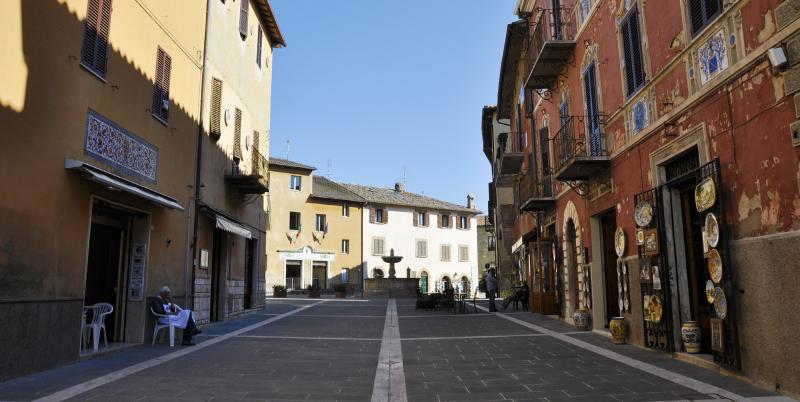
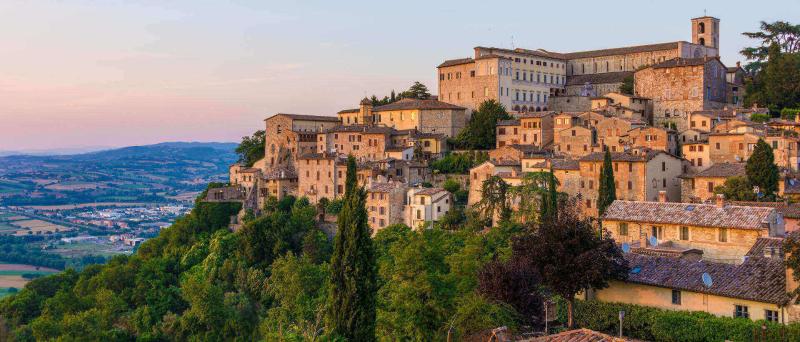
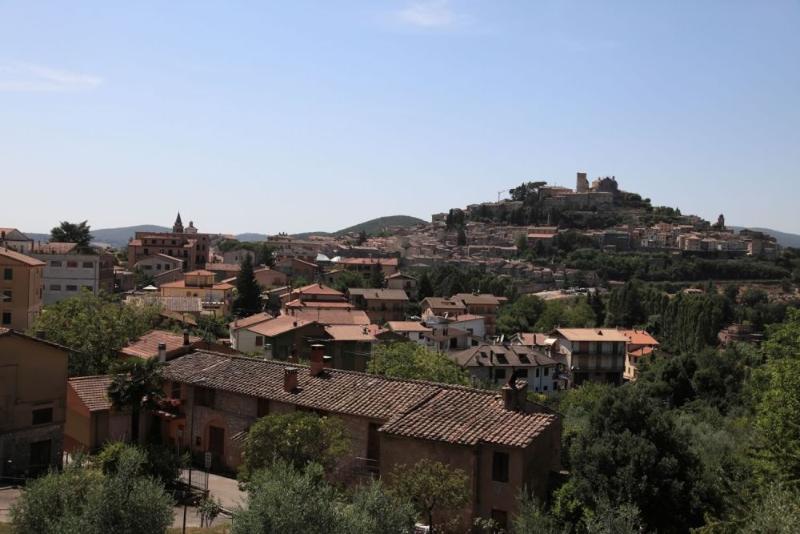
The first stage largely follows the permanent route of the Peace March, the annual walk/event linking the city of Perugia with the city of Saint Francis.
It may be regarded as a deviation from the historic Via Amerina, which originally led directly to Rome, although the city of Asisium was already an important Roman centre, as evidenced by the many remains from that period. It is a significant and unmissable stage, though it may be bypassed — for those already well acquainted with Assisi — by taking the variant from Ponte San Giovanni directly to Deruta.
A straightforward stage, almost entirely without elevation gain. The route begins in Assisi and descends into the Umbrian Valley as far as the Basilica of Santa Maria degli Angeli, which houses the Porziuncola, the small chapel that became one of the most important Franciscan sites.
The itinerary then continues across flat terrain to the outskirts of Bettona, a town listed among Italy’s Most Beautiful Villages, well worth a short detour. Shortly afterwards, the route turns decisively south, keeping to the left bank of the Tiber, until it reaches Deruta, another town included among Italy’s Most Beautiful Villages. By this point, the distance covered will be 22.5 kilometres.
If one chooses to continue to the Sanctuary of the Madonna dei Bagni, the official end of the stage, a further 2.5 kilometres must be added, for a total of 25 kilometres.
This stage is in fact quite easy, with the only real difficulty being the demanding final ascent to the town of Todi (250 metres of elevation gain over the last 1,500 metres).
The route begins at the Sanctuary of the Madonna dei Bagni and continues south, always keeping to the left bank of the Tiber. Stops and supplies will not pose any difficulty, as the walk follows minor roads through a great number of villages and small towns, while fast-flowing traffic remains confined to the E45–Tiberina road. Once Ponterio is reached, the short but demanding climb begins, leading up to the medieval centre of splendid Todi.
After descending from the historic centre, we take the straight Via delle Piagge, though not before making a short detour to admire the Temple of Santa Maria della Consolazione, an architectural masterpiece of Renaissance art, attributed to Bramante and situated at the foot of the town.
Just outside Todi, the route follows an unpaved road running alongside the Arnata stream, which is crossed further on by way of the fine Roman bridge of Pesciano. The itinerary continues along the watercourse as far as the remains of the ancient Ponte della Falce, near the mill of Pesciano. Here begins the most demanding ascent of the route, which leads to an elevation of over 500 metres. At the top stands a maestà, known as the Mestaiola di Sant’Eurosia. The path then starts to descend and, keeping the unmistakable outline of Forte Cesare on the right, finally reaches Castel dell’Aquila.
A short stage, designed to break up the Todi–Amelia section for those who may prefer not to cover 32 kilometres in a single day.
Leaving Castel dell’Aquila, the route continues along the provincial road towards Amelia, which remains the main direction as far as Sambucetole, although with numerous deviations onto paths and unpaved tracks in order to avoid asphalted stretches. At Sambucetole, the route heads towards Cappuccini, beginning an ascent that, with one hundred metres of elevation gain, leads to the Capuchin convent, formerly the Hospice of Saint James.
Amelia is already visible from here and is reached by continuing along the same road as far as the riverside park of the Rio Grande; a new wooden bridge then marks the way up to the town.
An easy stage with little positive elevation gain, yet highly interesting from both a naturalistic and an archaeological point of view.
The route leaves through Porta Romana and follows Via Primo Maggio as far as the Grotto of Lourdes, in the locality of Montenero. It then continues along the ridge road, where remains of the ancient Roman route can be seen, before beginning the descent towards the valley floor. The ruins of an ancient Roman funerary mausoleum herald the ford across the Rio Grande. Shortly afterwards, in the area known as Solfatare, there are several pools characterised by sulphurous emissions. The route then continues along the right bank of the Rio; near an old watermill, a rest area for pilgrims has been set up. It goes on until reaching the provincial road to Orte, which is left a few hundred metres later by turning right before the bridge. The unpaved track leads to the confluence of the Rio and the Tiber, where, a little further on, it is possible to visit the archaeological excavations of the ancient river port of Ameria.
The route then continues until rejoining the provincial road, only to leave it again shortly afterwards along a dirt track descending towards the Tiber. After a short while, and once past the underpass beneath the Autostrada del Sole, the route reaches the provincial road coming from Amelia; turning right, it crosses the Tiber and climbs up to Orte.
Elevation gain
+1483m | -1833m
Distance
118 km
Duration
6 days