
Trasimeno Way: circular route around the lake - La Via di Francesco

The Trasimeno route
A circular route of about 160 km through the beautiful villages of the area, with breathtaking views of the lake from the surrounding hills.
The Trasimeno route
The Trasimeno route is a path that is travelled with a unique travelling companion at its side: the lake and its hills. The itinerary allows visitors to discover the area, its beautiful landscapes and the hospitality of the people who live there.
The circular route can be completed in seven stages: since it is circular, there are no obligatory starting and finishing points, offering maximum freedom to those who wish to set foot on it, even if only for a simple day out in the beauty of nature.
The stages take place mainly on the rolling hills and fields of vineyards and olive groves that offer wide panoramic views of Lake Trasimeno, but also through the silences of the woods and medieval atmospheres: in fact, we encounter the castles of San Savino, Montali, and Mongiovino and pass through Panicale, Paciano and Castiglione del Lago, three of the most beautiful villages in Italy.
From Punta Navaccia it is also possible to embark on the discovery of the Maggiore island, the penultimate stage of the Cammino, from where - after savouring the pleasure of the ferry - the route resumes to take the wayfarers back to Passignano, not before crossing a panoramic road from which one can enjoy the view of the lake in all its beauty.
SEE DETAILS ON KOMOOT
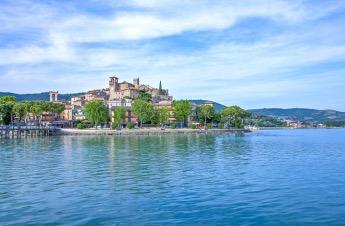
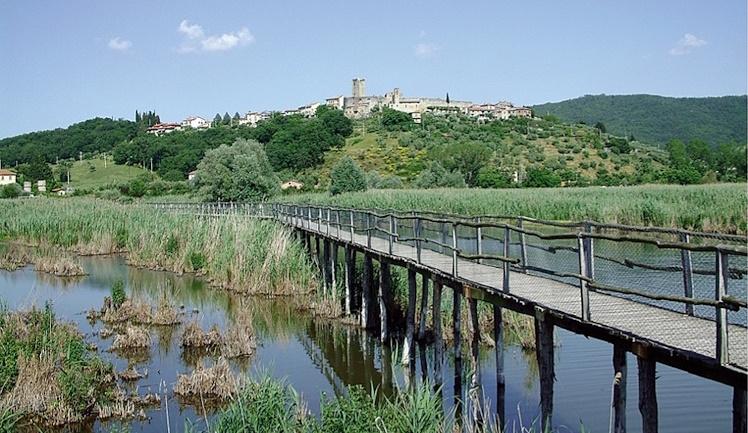
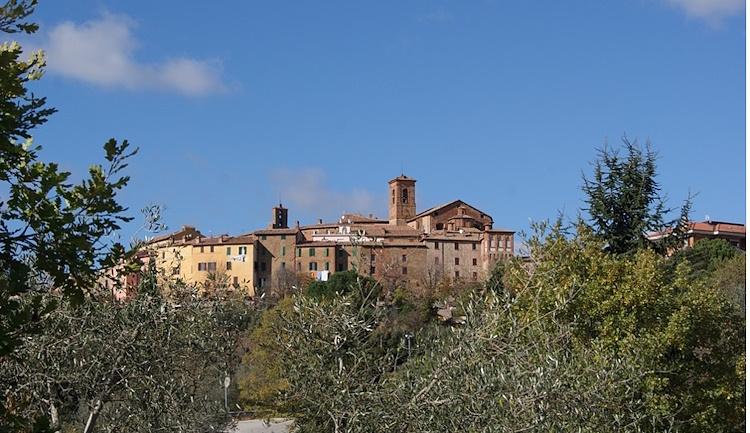
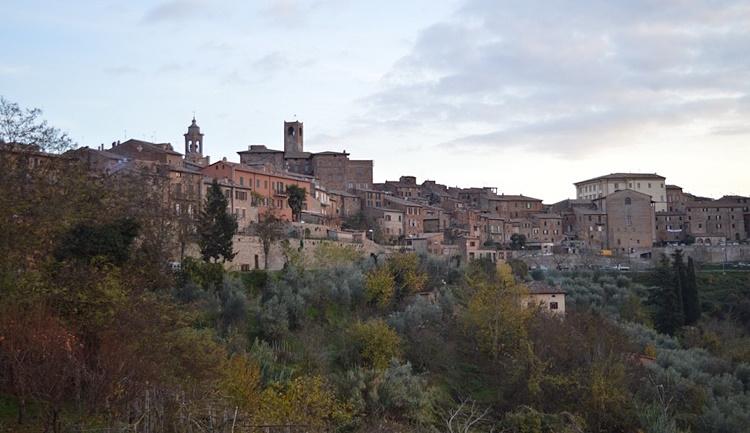
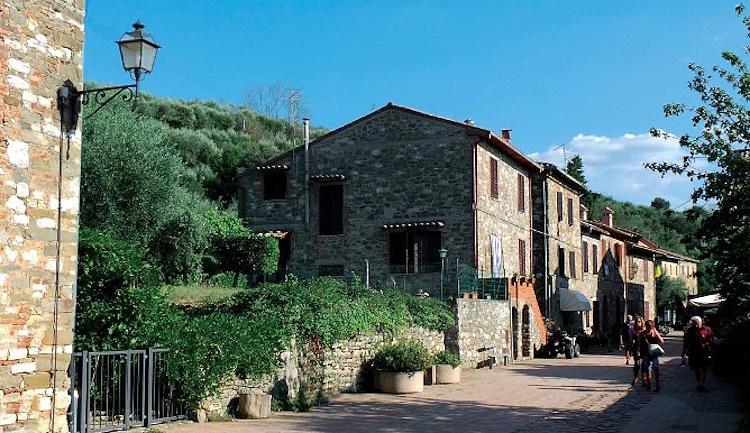
The first stage starts in Passignano sul Trasimeno, a lively village, thanks to the numerous cafés along the lake, and rich in history. Walking through the narrow streets of the historic centre, one arrives at the Rocca, which offers a splendid panorama of the lake.
The walk continues towards the hills above the village where it is possible to admire the Isola Maggiore and Isola Minore. You continue along a flat, open and scenic stretch of road and arrive at the tower of Monte Ruffiano, also known as the Torre delle Streghe (Witches' Tower).
From there you reach a rest area located right next to the archaeological site “La Valle Nature Reserve”. Through olive groves, woods and vineyards, we reach the village of San Savino, which, from above the La Valle Nature Reserve, offers suggestive sunsets.
San Savino, a small village on the south-eastern coast of Lake Trasimeno, is the starting point of the second stage. Dominating the village is its castle, a small fortress built in 1180, an important outpost for nearby Perugia, given its strategic position. Leaving San Savino behind, the itinerary continues until it reaches a forest, where most of the route unfolds. Wandering through woods, cultivated fields and olive groves, we arrive at Mongiovino Vecchio, a tiny village built around the medieval castle of the same name, which is currently used as an accommodation facility.
The route proceeds towards the final destination of the stage: Panicale. This village, perched on a hill, has a history closely linked to its castle, which in medieval times served as a refuge.
From Panicale, we set off along the Trasimeno route towards Città della Pieve. Having passed the historic centre, the route climbs slightly among olive trees until it enters a forest of oak and chestnut trees, at the end of which it reveals the village of Paciano.
This small medieval hilltop village is a treasure trove of architectural works enclosed by 14th-century walls. After a visit to Piazza Matteotti, the route continues along white roads surrounded by greenery. The last section of the itinerary, an open and undemanding route, ends with the arrival in Città della Pieve.
Known for being the birthplace of the famous Renaissance painter, Pietro Vannucci, known as Perugino, this red-brick village is home to notable monuments of historical and cultural interest.
The fourth segment of the Via del Trasimeno involves a walk of about 3 km along the road travelled during the previous stage, to avoid busy roads. We pass the “Tre Mulini” farm and enter a wood that leads to the small hamlet of San Donato, consisting of a few clusters of small houses. Further on, having crossed the state road, the path continues along white roads and leads to the pretty hamlet of Cantagallina.
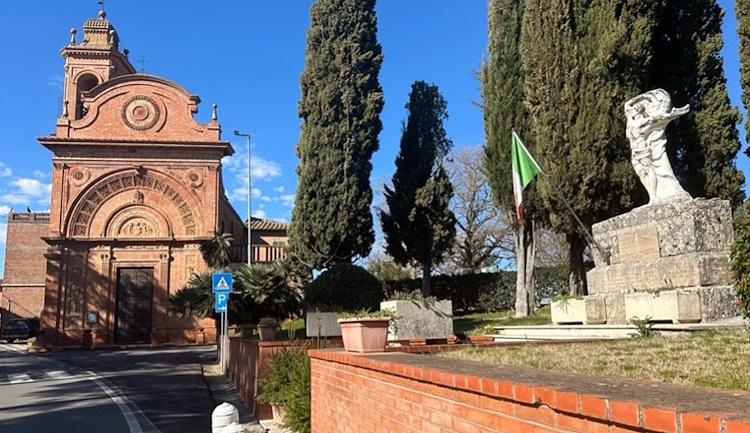
A 30-minute walk takes you to the final destination of this stage: Villastrada, a small village with a few shops and accommodation facilities. The pride of the village is the Church of Santa Maria delle Grazie, built in the early 20th century by architect Ercole Crescenzi of Panicale.
Following a dirt road before the bar, we set off from Villastrada to reach Castiglione del Lago. On the way, which is in open countryside, we pass through several small hamlets including Gioiella and Vitellino to continue towards Lake Trasimeno.
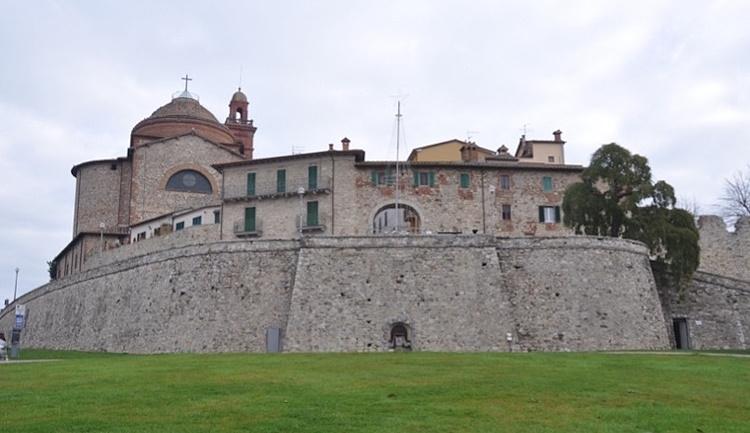
Eventually you arrive at your destination, in the picturesque lakeside village of Castiglione del Lago, now located on a promontory, but which until the lake’s waters subsided was its fourth island. It is a mediaeval town that contains monuments of great historical and artistic importance within its historical centre, such as the Rocca del Leone, dating back to the 13th century, whose patrol path offers a splendid panorama of the lake and its islands; also noteworthy is Palazzo della Corgna, built in 1560, with its richly frescoed interior.
After a walk along the central avenue of Castiglione del Lago, a descent to the lakeside marks the beginning of the sixth stage of the walk. We leave the village behind us, following a pedestrian and cycle path that allows us to fully enjoy the beauty of the Trasimeno Regional Park. There are numerous resting and refreshment areas in the hamlets of Badiaccia and Borghetto, where there are campsites overlooking the lake. Once past Borghetto, the trail continues towards Punta Navaccia (Tuoro sul Trasimeno), crossing the territories of Hannibal's battle. From there we embark to reach Isola Maggiore, the final destination of this sixth stage. The island, which hosted St Francis in spiritual retreat, is the ideal place to breathe in the atmosphere of peace and tranquillity that permeates Lake Trasimeno. There are accommodation and catering facilities, as well as a small village that comes alive in the summer months.
Points of artistic and cultural interest include the Museo del Merletto (Lace Museum), which testifies to the traditional local production of Irish lace, and the Church of San Michele Arcangelo, dating back to the 13th century and located at the highest point on the island. The church, richly decorated with valuable frescoes, is the ideal vantage point to celebrate the end of the stage by admiring a suggestive sunset over Lake Trasimeno.
After a restful stop on Isola Maggiore, for the seventh stage we set off by ferry back to Punta Navaccia, and then proceed to Tuoro sul Trasimeno. Located on the northern part of the lake, this village, one of the most important in the area, is known for the Battle of Hannibal that took place here in 217 BC. Evidence of this battle is collected in the Hannibal Museum located in the historic centre of the village, where you will also find the Church of Santa Maria Maddalena, defined by Pope Leo XIII as a “little St. Peter” for its 23-metre-high dome. The route then continues to Sanguineto, a small hamlet of Tuoro, and climbs up to the panoramic road, from which one can again admire the lake from above in all its beauty. Continuing along the path, we then reach Gosparini, another suggestive panoramic point, where it is possible to stop for a rest.
After a few kilometres through woods and olive groves, we reach Passignano sul Trasimeno, an ideal destination for a pleasant walk along its lakeside promenade and to admire a wonderful sunset, toasting the end of the stage at one of its many bars.
Elevation gain
+ 3.260 m | - 3.260 m
Distance
153 Km
Duration
43 h 17 m
How to get there:
By car:
- Autostrada del Sole (A1), exit “Valdichiana” for those coming from the north, exits “Fabro” and “Chiusi-Chianciano Terme” for those coming from the south.
- E45, exit “Perugia”, direction Lago Trasimeno
By train:
- Direction Milan-Florence-Rome: Castiglione del Lago, Chiusi-Chianciano Terme or Terontola stations
- Direction Ancona-Foligno-Florence: Passignano sul Trasimeno or Tuoro sul Trasimeno stations
For further information:
Please refer to the website http://www.laviadeltrasimeno.org/